Increase productivity by breaking these 9 bad habits
If you struggle to make the most of your time and be more productive, we’ve got you covered. Here at Yomez, we’ve compiled nine bad habits you can change to increase productivity and start accomplishing what you set out to do. We’ve also included a few ways you can keep those bad habits at bay. Check it all out below.
1. Enabling distractions
In today’s world, it’s easy to be distracted. The technological advancements we’ve seen in our lifetime have surpassed many of our expectations. We enjoy incredible conveniences, access to the world’s information, and near-limitless communication and connectivity opportunities. However, these advancements have also given way to endless distractions.
When building habits to increase productivity, it is essential to stop enabling distractions. Try the following:
- Turn off notifications while you work. This includes email, social, texts, and other alerts that keep your attention away from your work. Using the Do Not Disturb function is a convenient way to avoid distractions from notifications. If you’re worried about being contacted about an emergency while your phone is on Do Not Disturb mode, set your phone to allow calls from select friends and family so, you can still stay in touch with those most important to you.
- Keep your phone away from your workspace. Put your phone away or where you can’t get to it easily—out of sight, out of mind. This tactic can help keep you focused on your work and not on your phone.
- Schedule chit-chat. Chit-chat in the workplace is often unavoidable. Consider setting 15-minutes aside as part of a break to grab coffee with your favorite colleagues or catch-up after work. This approach is a great way to stay on task while also allowing for team building and bonding with your work buddies.
2. Not time blocking
I have a few friends that keep a mental list of the many things they need to do. They’ll randomly select what needs to get done and just do it. Although I applaud their ability to remember their list and their motivation to get started, I’ve noticed that their method isn’t the most effective to make progress on tasks or projects.
My friends often get caught up on one task, neglecting something else that is of equal—and sometimes greater—priority. On occasion things on their to-do list aren’t accomplished until much later—which presents a slew of logistical and scheduling issues.
To be most effective with your time and energy, I recommend Time Blocking. This is the practice of designating time on one’s calendar to accomplish specific tasks. Time blocking also enables you to take action on various responsibilities so you can make gradual progress on more than one project and make the most of your time.
Here’s how this works:
Say you need to complete a presentation by next Friday. On your calendar, you dedicate two hours on Monday and two hours on Wednesday to complete your presentation deck for a total of four hours.
Doing so creates a few benefits:
- You recognize your limitations, in this case, a time limit of four hours.
- Time blocking helps you visualize and understand your availability so you can time block other tasks or projects.
- You understand your goal; in this example, it’s the need to complete the presentation
- You make your goal manageable by splitting the task into two-hour sessions instead of expecting to finish it all at once in one go.
By reserving time on your calendar—or time blocking—you can also show others who have access to your calendar exactly when you’re busy. This tactic gives you control over what derailments you invite into your schedule and when.
Time blocking is a beneficial practice but can be a tedious task in itself. A time management app like Yomez, automatically time blocks your to-do list according to task priority, effort, and due dates, so you can focus on what matters.
3. Focusing on urgency over importance
Although they sound like the same thing, there’s a critical difference between urgent tasks and important tasks. Understanding the difference is a crucial component to improving productivity.
Think of importance as a label or category for any task or activity that is aligned with and supports a larger goal or objective. Urgent, on the other hand, is a label or category that simply indicates that an activity is time-sensitive and requires your immediate attention.
By breaking down your to-do list according to urgency and importance, you can better balance your time. This practice helps you make progress on your goals with greater ease and efficiency.
Eisenhower Decision Matrix
At Yomez, we’re huge fans of using the Eisenhower Decision Matrix for prioritizing to-do lists. This tool makes prioritization a piece of cake. Take a look:
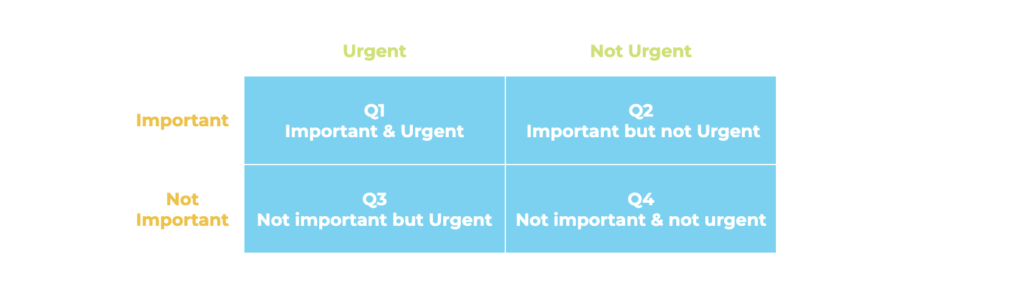
The matrix helps you sort your to-do list by categorizing it into these four buckets:
- Quadrant 1: The tasks that sit in Q1 must be addressed immediately and important, for instance, an emergency phone call.
- Quadrant 2: The items that sit in Q2 are those most aligned with your goals or objectives. These are tasks that bring you closer to your goal. These are scheduled in your calendar to make gradual and continual progress, like running daily in prep for a marathon.
- Quadrant 3: Responsibilities in Q3 also needs to be addressed with urgency, but it’s something you can delegate to another person, like sending your laundry out.
- Quadrant 4: Q4 is inconsequential and shouldn’t occupy your time, like checking social media.
Want to learn more about how to use the decision matrix? Check out our blog post, Urgent and important: what’s the difference. We walk you through the process, complete with examples.
4. Not taking breaks
For those of you who are successful in achieving a deep focus, this one’s for you.
It is critical that we give ourselves breaks throughout the day. Just like an athlete, if you’re not well rested and in good shape, you’ll experience suboptimal performance.
Let’s examine some of the short and long term effects of not taking breaks:
- Staring at a computer screen for long periods can cause eyestrain. Breaks allow our eyes to rest and refocus.
- Remaining sedentary can have serious health effects, including blood clots, heart disease, tight and painful hip flexors, lower back pain, and weight gain. Walking away from your desk and stretching your legs a few times a day can mitigate the impact of a sedentary lifestyle.
- Focusing for too long leads to decision fatigue. Examining work with fresh eyes can help you sort out obstacles, reveal errors, and critically think about important decisions.
5. Poor diet
When you’re busy, it’s not uncommon to neglect one’s diet. I tend to forget to eat lunch when I’m in an intense and extended period of focus—this is a huge mistake.
Your body needs the appropriate fuel to concentrate. If you’re hungry and uncomfortable, it’s unlikely that you’ll focus. Further, your brain uses energy to make decisions, work through problems, and respond to stimuli or stressors. When stressed due to your workload, your body uses more energy in an attempt to manage the production and the effects of cortisol and adrenaline.
Fueling your body with the right foods is critical to productivity. So the next time you’re getting ready to have a productive day, consider keeping a few of these items nearby as a quick snack to help you through:
- Blueberries. Blueberries deliver anthocyanins, a group of plant compounds with anti-inflammatory and antioxidant effects. Antioxidants prevent oxidative stress and inflammation, conditions that may contribute to brain aging and neurodegenerative diseases
- Broccoli. Rich in vitamin-C and flavonoids which promote healthy brain function. Broccoli is also rich in fiber, which supports colon health.
- Nuts and seeds. Nuts and seeds are rich in healthy proteins and omega-3 fatty acids, which keep your energy levels elevated.
- Oranges. You can get all the vitamin C you need in a day by eating one medium orange. As mentioned, Vitamin C is critical to healthy brain function.
- Avocado. Apart from being creamy and delicious, avocados are rich in monounsaturated fatty acids. These acids help protect glial cells in the brain called astrocytes. Astrocytes provide support to information-carrying nerves.
Avoid processed sugars that will spike your glucose levels and send you crashing.
6. Doing too much at once
The human brain can only focus on one thing at a time, which is why multitasking doesn’t increase productivity but instead slows us down. To be more productive, quit multitasking. Here’s why:
- Preventing critical thinking and innovation. Without focus, we cannot think long and hard about an idea. Without the ability to think critically, we deliver subpar results.
- Impairing production quality. When we don’t focus, we make mistakes. When we make mistakes, we have to invest more time on a task to correct it.
- Taxing our productivity. Switching between things costs us time—we need approximately 23 minutes and 15 seconds to refocus on something.
In addition to slowing us down, multitasking creates stress. When you try to split your attention simultaneously across many tasks, your brain reacts with the flight-or-flight response. Prolonged exposure to stress has tremendous effects on our health. What can one do instead of multitasking? Read this blog post to learn more.
7. Not making time for fun, rest, or relaxation
You read that correctly. We all need an opportunity to do things we enjoy. These activities can help us recharge and improve mental health, which increases productivity. The benefits of engaging in activities you find interesting include:
- Reduced stress as a result of decreased cortisol production. When we are stressed, we have too much cortisol in our body, which causes anxiety, affecting focus and mood.
- Improved mood caused by increased serotonin levels. One of the causes of anxiety and depression is low serotonin levels. When we elevate those levels, we stabilize our mood, reduce stress, and improve focus.
- More sleep as a result of decreased cortisol levels and increased serotonin. As mentioned, cortisol causes anxiety, and serotonin can help reduce it. Serotonin and cortisol both play a part in one’s ability to get sleep. Getting proper sleep directly impacts these other factors. It’s all cyclical!
Some may express feelings of guilt when taking time to relax or have fun. If you find yourself thinking this way, consider and repeat the following thoughts to yourself:
- By taking time to rest, relax, and have fun, I am enabling myself to be more productive by tending to my mind, body, and spirit.
- Leisure is a necessary part of life and an excellent reward for focused and productive work.
If you still feel anxiety about allowing yourself what is natural and necessary—a bit of fun and rest—consider scheduling it into your calendar. Think of the time needed to rest as a
8. Aiming for perfection
The adage, perfection is the enemy of good, still holds today.
Although an ideal pursuit, aiming for perfection in the context of a goal or project, isn’t realistic. The idea of perfection is subjective, and your perception of it can evolve. If you aim for perfection, you may never call a task complete, as perfection is unattainable. By striving for perfection, you ignore other, more productive, attainable goals.
Instead, aim for good rather than perfection and allow yourself to iterate or gradually improve upon an outcome or result. By splitting a larger ambitious objective into smaller milestones, you make a goal more manageable and remain agile.
9. Missing out on goals
Goals are the destinations in your life’s journey. If you don’t know where you are going, how do you know if you’re on the right track? Here are a few reasons why setting goals can help you increase productivity:
- Goals inform action. You are more likely to engage in an activity that brings you closer to your goal, adding meaning to your days and greater focus.
- They’re something for which to look forward. As you invest more time on your goal, you’ll find yourself excitedly looking forward to each day, and living with purpose. It’s this purpose that keeps you on track, driving you to make the most of your time and increase productivity.
- Make yourself proud. Goals test you. You may need to exercise more discipline, focus, and determination than ever before. Stepping outside of your comfort zone and engaging in skills or activities you may have otherwise avoided, can be a source of enormous personal growth, satisfaction, and pride.
The start of a new, more productive chapter
So there you have it, the nine bad habits you can change to increase productivity. If you find yourself doing one or more of these things, pick one and get started. Once you make progress on that one habit, you can choose another, gradually working your way down the list. As we outlined above, don’t aim for perfection!