Time Management
In this blog post, we’ll explore time management and all its various facets. You’ll learn:
- What time management is
- Why time management is important
- Different time management techniques
- How to improve your time management skills
By the end of this blog post, you’ll come away with the necessary tools to start making the most of your time and become the most effective version of yourself. Ready to get started? Let’s go!
What is time management?
Time management is the practice of strategically organizing and dividing your time across your various life roles and responsibilities. When done well, time management enables you to be more effective by getting more of the right things done in less time.
Why is time management important?
It’s completely normal and not uncommon to feel overwhelmed by the various roles and responsibilities one must carry out each day. Time management can help you stop feeling weighed down by your different responsibilities and instead help you feel empowered to make the most of each day. With time management, you’ll bring balance to your life, reduce stress, and accomplish more.
How can I manage my time?
Lucky for you, you’re not the first to ask this question! Throughout history, men and women have dedicated their lives to studying time management, what it is, and, most importantly, how to master it. Thanks to their hard work and dedication, we can skip through figuring that all out and jump straight to implementing the techniques they worked so hard to establish. Thanks, guys!
Below, we’ve outlined a few of the most effective and influential time management techniques to help you get started on your time management journey.
Pareto Principle or the 80/20 Rule
The Pareto Principle was established by Vilfredo Pareto, an Italian economist, and philosopher. Pareto stated that for many outcomes, 80 percent of consequences came from 20 percent of the causes for any given event. So, what does this principle really mean for you and your productivity? Well, let’s break it down.
Grab a pen and paper. Now write down a list of ten tasks or action items that you must complete today. Do you have your list? Great. Now consider which of these activities you’d do today if you could only complete one. Which item would have the most significant impact on your life or work? Take another look at your list. Now pick out the second most important item on that list.
These two items that you’ve identified are the top 20 percent most important responsibilities on your list. This 20 percent is where you should focus 80 percent of your time and energy. The remaining items on your list are the bottom 80 percent. These are the tasks and activities that should occupy about 20 percent of your time and energy.
To get the most out of this technique, we recommend repeating this exercise with a week’s worth of tasks and responsibilities. By focusing on a week at a time, you’ll figure out where you will get the greatest output for your efforts, eventually driving greater effectiveness. Try it out!
Pomodoro (or Tomato) Technique
The Pomodoro Technique was created by another Italian time-management aficionado, Francesco Cirillo. Cirillo used a tomato-shaped kitchen timer to track his focus on tasks and named his new time management methodology after the crimson fruit.
The Pomodoro Technique brings improved focus on the task at hand. The Pomodoro Technique is an excellent complement to the 80/20 rule, as it can help you focus your time and energy on what you’ve identified as your focus for the day. Here’s how it works:
Step 1: Identify the items you need to complete today. Then, try implementing the 80/20 rule, identifying the two priorities for the day that should occupy 80 percent of your time and energy.
Step 2: Get started with your first 30-minute session consisting of a 25-minute focus session and a five-minute break. Set a timer for 25-minutes, and begin. You’ll want to ensure your timer is clearly visible to you so you can track your timing. Focus solely on the task at hand—do not engage distractions. When the timer goes off, this concludes your first, “Pomodoro.” Place an X beside your task on your list to indicate the completion of your first session.
Step 3: You now have a five-minute break. All work should conclude once the timer rings, even if you feel like you should or can continue. When focusing intensely on one task, it’s good to give yourself a quick break and reset to avoid burnout.
Step 4: You’ll want to repeat the same steps, placing X’s beside your task each time you complete a session. Each time you accomplish four sessions, you take a more extended break, between 15 to 30 minutes. You’ll continue focusing on your task until it’s complete.
Step 5: At the end of the day, you’ll have accumulated some valuable insights about the estimated amount of time it takes you to complete a task, measured by the X’s you’ve placed on your list. You’ll also see how much time you spend on focused work throughout the day. These insights can help you in the way you approach and plan out your days.
Eisenhower Decision Matrix
Our 34th president, Dwight D. Eisenhower, knew that to prioritize his many pressing responsibilities effectively, he must discern between and separate the important tasks from the urgent ones. It is said that he applied this methodology, of categorizing his tasks between urgent and important ones, to prioritize his workload. Now, you might be thinking, What’s the difference between urgent and important tasks? Well, let’s take a look:
- Urgent: indicates that an activity is time-sensitive and requires your immediate attention.
- Important: Think of importance as a label or category for a task or activity aligned with or supporting a larger goal or objective.
With the Eisenhower Decision Matrix, you can easily prioritize your tasks as either Urgent or Important, and somewhere in between.
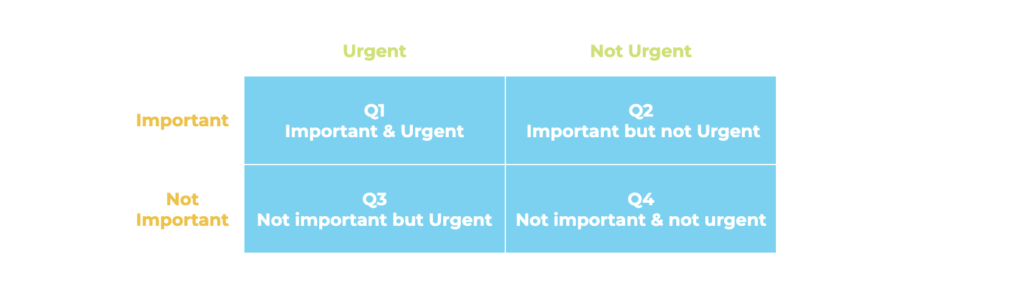
Q1 – Urgent and Important:
These activities or tasks are things that come up, which must be solved quickly and are of consequence to one’s goals.
Q2 – Important and not urgent:
This is the prioritization sweet spot. These are the things that, if we do them, will bring us closer to achieving our goals and objectives. Since these tasks are not urgent, they are more difficult to do as they usually provide delayed gratification (versus urgent tasks, which provide instant gratification).
Q3 – Not important and urgent:
These are things we feel compelled to do immediately but are of no real consequence to our goals or objectives. For example, reading email constantly or answering a phone call. Focusing on these tasks might be tempting because they provide near instant gratification, but provide little value to our effectiveness. By reducing or eliminating these tasks, we free-up more time to focus on more pressing areas.
Q4 – Not important and not urgent:
These are usually the activities or things that add little or no value to our success or goals. They are often pleasant or enjoyable, like watching Netflix or YouTube, or browsing social media.
If you want an in-depth look at leveraging the Eisenhower Decision Matrix, check out our blog post dedicated entirely to the technique.
Time blocking:
Time blocking is another time management strategy that involves scheduling time on your calendar for all your tasks. Here’s how you can time block:
One: Make a list of the items that you need to tackle today.
Two: Estimate how much time you need to accomplish or address each task.
Three: Schedule time directly on your calendar to tackle each of your tasks.
Pros and Cons:
Time blocking is a helpful strategy that keeps you and your calendar organized and encourages you to be intentional, make a plan, and commit to using specific times to accomplish tasks. However, it does have its limitations.
Time blocking is a manual process. It can be time-consuming to schedule small blocks of time and challenging to manage over several days. Additionally, an unexpected change in your schedule can derail your plans and can cause you to reschedule all your time blocks.
Time management skills
These time management techniques will help you be more organized, make the most of your time, and help you prioritize your tasks and responsibilities. Now that you know more about different time management techniques, check out how to improve upon your time management skills. You’ll learn how to make small adjustments in your day-to-day that will yield tremendous results. Goal Setting
An essential—and often forgotten—component of time management is goal setting. Goal setting is arguably one of the most important aspects of time management. Of course, you could decide never to develop a single goal and still manage your time well, being as productive and efficient with your time as possible. But to what end?
Setting sail…and goals
Imagine you are a ship. Your life—the way you spend your time—is your ocean voyage. The goals you set are the destinations on your journey. Without goals, how do you know if you’re on course? An ocean voyage without a destination isn’t really a trip; it’s more like aimless wandering through the ocean. With a destination, your trip suddenly gains purpose enabling you to see and experience much more. When you know where you need to go you can devise a plan on how to get there, how long it should take, and what kind of support you’ll need—important details to managing your resources like time, energy, and money.
When you set goals, you invite greater purpose into your life. Goals can help you assess where you want to go in life. By viewing your time through the lens of a goal, you can prioritize your time more effectively. Your energy goes into accomplishing things that will bring you closer to your goals. Without goals, we are more likely to mismanage or misspend our time.
However, goal setting can be challenging if you’ve never done it before. To help you, we put together a self-guided workshop that walks you through, step-by-step, how to create thoughtful goals for yourself. Check it out!
Stop multitasking to improve focus
Studies have shown that multitasking hinders your productivity as it prevents you from developing deep focus, in addition to contributing to a slew of health issues. Here’s how to stop spreading yourself thin and start focusing:
Address one thing at a time
Big surprise, right!? Who would have thought that the solution to multitasking is to do one thing at a time? It probably seems obvious, but making an effort to focus on a task for a specific amount of time can make you more effective. Let’s look at how.
With your attention split amongst several tasks, you’re more likely to experience anxiety and fatigue. When we task-switch, like switching our attention from writing an email to checking the news, we use a little bit of energy. When we do this multiple times a day we use up more energy. With less energy, our struggle to make decisions throughout the day and keep focus, leading to cognitive impairment.
By focusing your attention on one task or project at a time, you’ll be more effective as you’re more likely to finish your task at hand, reduce anxiety or overwhelm, and mitigate exhaustion.
Be intentional with your time
Setting time aside throughout the day dedicated solely to accomplish a specific task is a great way to be intentional with your time. Tracking your task time will also bring greater awareness to how long it takes you to complete it. You might think that it only takes an hour to write that recap for your boss, but it may take two hours when you’re stopping every few minutes to check your Instagram account.
This is where techniques like Time Blocking and the Pareto Principle can be beneficial.
Avoid Distractions
Give yourself a fighting chance to actually focus. Reduce the number of distractions around you when you’re trying to get in “the zone” by:
- Eliminating devices that may take attention away from your phone like TVs, phones, and table
- Designating times to review and respond to email, text messages, and social media, and stick to them
- Dedicating time to quick breaks, so you don’t become overwhelmed
Create a zen workspace
Ensure focus by creating an environment that supports productivity. With so many of us working from home these days, you’ll want to dedicate a Zen space to your work. To create one, consider:
- If you’re working from home, a dedicated work space separate from other activities will help divide work from personal life. This is necessary when you need to keep focus or disconnect from work and rest.
- Get the right gear. Don’t dismiss the effect tools can have on your productivity like a second monitor, a comfortable chair, and a pair of noise-canceling headphones.
Delegate responsibilities
Wanting to do it all ourselves is not uncommon. But knowing when to ask for help and delegating tasks is an important skill to hone as it can drastically alter your time management and productivity for the better.
Delegating may seem overwhelming at first. You might even tell yourself, It’s just easier if I do it myself rather than explain everything, but try to fight that instinct! Although delegating tasks may require a bit of extra elbow grease at the start, you’ll see the benefits in the long run. Once you’ve got the hang of delegating tasks, you’ll start to realize that you’re not only enjoying more free time, but tasks get completed more quickly. Here are some tips to help you get started:
- Delegate tasks to someone you trust: Trust is crucial as you want to ensure the person carrying out the work is reliable
- Provide direction and clear expectations: Explain the process for the task and clearly define expectations. Doing so helps drive success
- Check-in and provide guidance: Sometimes, your support system will need some feedback to ensure the job is on the right track. It can be helpful to have the person who is being delegated define their understanding of the expectations, check-ins, success criteria, and consequences (good and bad) to ensure alignment.
- Show Gratitude: Once the task is complete, be sure to say thanks! A little appreciation goes a long way
Get Started with time management
With all these new techniques and skills, you might be a little unsure about how to start mastering your time. No worries, we got you covered. Here’s some advice:
Don’t be afraid to change your habits
Similarly to delegating tasks, changing your time management habits can feel a little iffy, but trust the process. It takes time to form new habits and break old ones. Be patient with yourself—you got this!
Plan a week in advance
Ease into new habits, especially when it comes to time management. If you try to time manage too far into the future, you will inevitably become overwhelmed and stressed. So, take it easy. Try planning a week ahead at first and see how that goes. As you get better with planning and time management, you can try scheduling tasks and responsibilities two weeks in advance, so on and so forth.
Use the tools at your disposal
There are plenty of tools you can lean on to help you manage your time. Use your calendar, get timers or download apps that can help you keep track of your goals and priorities, like Yomez.
Remember those folks we mentioned at the start of the blog post—the ones who dedicated their lives to understanding and mastering time? Well, many of them wrote helpful books that have inspired and guided thousands in their own time management and productivity journeys. Our CEO, Doron Gan, recommends the following:
- Indistractable
- Deep Work
- Atomic Habits
- 7 Habits of Highly Effective People
If you want to learn more about some of these books, check out the blog post, Top 5 Books for Improving Productivity.
Dive in there
Sometimes the best way to start is by getting started. Either select a small objective like completing a task within a specific time frame, or go big, like sitting down to determine your personal goals. Whatever you decide, remember, everyone’s journey is different, and the important thing is to get started.